When a permanent disability makes it difficult or impossible to leave home regularly, some wartime veterans and their surviving spouses qualify for an additional monthly payment on top of their VA pension. It’s called the VA Housebound benefit — and it’s one of the least-discussed VA programs available.
Most families searching for help have heard of Aid & Attendance. Fewer know that a separate benefit exists specifically for those who are substantially confined to their homes. The two programs operate within the same VA pension framework, pay different amounts, and have different eligibility criteria — and understanding which one applies can make a meaningful difference in monthly income.
This guide covers how VA Housebound benefits work, who qualifies, what the 2026 payment amounts are, how the benefit compares to Aid & Attendance, and how to apply.
What Are VA Housebound Benefits?
The VA Housebound benefit is an enhanced level of VA pension available to wartime veterans and their surviving spouses who meet two conditions: they must already be eligible for a basic VA pension, and they must be substantially confined to their home or immediate premises due to a permanent disability.
It functions as an add-on to the base pension — not a separate standalone payment. If a veteran or surviving spouse receives no VA pension at all, the Housebound benefit cannot be accessed on its own. The pension eligibility comes first; the Housebound allowance increases that benefit amount to reflect a greater level of need.
Like Aid & Attendance, the Housebound benefit is tax-free and paid as a direct monthly deposit. The funds can be used for any purpose the recipient chooses — there is no requirement to spend the money on specific care services or care providers.
Important distinction: The VA Housebound pension benefit discussed in this article applies to wartime veterans and surviving spouses through the VA pension system. A separate program called Special Monthly Compensation Level S (SMC-S) uses the term “housebound” for veterans with service-connected disabilities. These are different programs with different eligibility rules. If the veteran’s disability is service-connected, SMC-S is the relevant program — not the pension-based Housebound allowance described here.
2026 VA Housebound Benefit Rates
The Housebound benefit rate is set annually and is based on the Maximum Annual Pension Rate (MAPR) for the Housebound level. These figures are effective December 1, 2025 through November 30, 2026.
- Single veteran (no dependents): up to $1,776 per month
- Veteran with a spouse or dependent child: up to $2,223 per month
- Surviving spouse (no dependent child): up to $1,190 per month
- Surviving spouse with a dependent child: up to $1,490 per month
These figures represent the maximum possible payment — the amount a qualifying veteran or surviving spouse would receive if they had zero countable income. The actual monthly benefit is calculated by subtracting countable income (after allowable deductions) from the applicable MAPR. Most recipients receive less than the maximum, depending on their income situation.
How income affects the benefit: The VA does not simply pay a flat Housebound rate. It pays the difference between your countable income and the MAPR. If your countable annual income is $8,000, and the MAPR for a single veteran is roughly $21,300, the VA would pay approximately $13,300 per year — or about $1,108 per month. Unreimbursed medical and care expenses can reduce countable income and increase the benefit.
For a full breakdown of current pension rates at all levels — including Aid & Attendance and the base pension — see our 2026 Aid & Attendance benefit rates guide.
Who Qualifies for VA Housebound Benefits
Qualifying for the Housebound benefit requires meeting three separate sets of criteria: the veteran’s military service, the financial requirements, and the medical or disability standard that establishes housebound status.
Military Service Requirements
The Housebound benefit is part of the VA pension system, which means the veteran must have served during a designated wartime period. The service requirements are the same as for Aid & Attendance:
- At least 90 days of active-duty military service
- At least one day of that service during a qualifying wartime period
- An honorable or other-than-dishonorable discharge
The qualifying wartime periods are World War II (December 7, 1941 – December 31, 1946), the Korean War (June 27, 1950 – January 31, 1955), the Vietnam Conflict (August 5, 1964 – May 7, 1975, or November 1, 1955 – May 7, 1975 for service in the Republic of Vietnam), and the Gulf War (August 2, 1990 to present).
The veteran does not need a service-connected disability to qualify. The Housebound benefit is based on financial need and a current disability that confines the veteran to the home — not on how or whether the disability is related to military service.
Financial Requirements
The Housebound benefit, like all VA pension benefits, is needs-based. The VA evaluates both net worth and income to determine eligibility and benefit amount.
The 2026 net worth limit is $163,699. Net worth includes countable assets plus annual income. The primary residence and personal vehicle are excluded. Some assets, particularly those related to care expenses, may be partially excluded as well.
Income is evaluated after deducting unreimbursed medical expenses — including the cost of in-home care, prescription medications, health insurance premiums, and other out-of-pocket medical costs. These deductions can significantly reduce countable income and, in some cases, bring a veteran or surviving spouse within range of qualifying even when income initially appears too high.
For a detailed explanation of how the VA calculates income and net worth, including what’s counted and what’s excluded, see our guide on VA Aid & Attendance income and net worth requirements. The same framework applies to the Housebound benefit.
The Housebound Standard: What “Substantially Confined” Means
To qualify at the Housebound level, the veteran or surviving spouse must meet one of two medical conditions:
- Permanent disability that substantially confines them to their home and immediate premises — the disability makes it difficult or impossible to leave the home except for medical appointments or very infrequent outings. The disability must be permanent in nature.
- A single permanent disability rated at 100% disabling, plus another separate disability rated at 60% or higher — this pathway applies even if the person is not physically confined to the home, as long as the combined disability burden meets this threshold.
“Substantially confined” does not mean the person can never leave home. The VA recognizes that leaving home for medical appointments, essential errands, or brief outings does not disqualify someone. What matters is that the disability prevents regular, routine activity outside the home — not that the person is completely homebound.
Note: A physician’s statement documenting the disability and its effect on mobility and daily activity is required as part of the application. The same form used for Aid & Attendance — VA Form 21-2680 — is used to document housebound status. A medical doctor, doctor of osteopathic medicine, physician assistant, or advanced practice registered nurse can complete the examination section.
Housebound Benefits vs. Aid & Attendance: Key Differences
Both the Housebound benefit and Aid & Attendance are enhanced levels of the VA pension, and both are available to wartime veterans and surviving spouses. But they are not interchangeable — they have different eligibility criteria, different payment rates, and cannot be received at the same time. Understanding the distinction helps determine which program is the right fit.
Not Sure Which Benefit You Qualify For?
Our Benefit Specialists, working under the guidance of our VA-accredited attorney, offer a free consultation to help veterans and surviving spouses understand whether Housebound benefits, Aid & Attendance, or another program best fits their situation.
Get a Free ConsultationWho Each Benefit Is Designed For
Aid & Attendance is designed for people who need regular help from another person to perform activities of daily living — bathing, dressing, mobility, toileting, or eating. It can also apply to people who are bedridden, nursing home residents, or those with severe vision impairment. The focus is on the need for personal care assistance, regardless of where the person lives or how mobile they are.
Housebound is designed for people whose permanent disability substantially confines them to the home and immediate premises. The focus is on mobility and confinement rather than on the need for personal hands-on assistance. A person can qualify for Housebound without needing help with bathing or dressing — if they simply cannot leave home regularly due to a permanent disability.
Payment Amounts
Aid & Attendance pays more than Housebound because it reflects a greater level of dependency. For 2026:
- Aid & Attendance — up to $2,424/month (single veteran), $2,874/month (married veteran), $1,558/month (surviving spouse)
- Housebound — up to $1,776/month (single veteran), $2,223/month (married veteran), $1,190/month (surviving spouse)
The Cannot-Receive-Both Rule
The VA does not allow a veteran or surviving spouse to receive Aid & Attendance and the Housebound allowance at the same time. If someone qualifies for both on paper — meaning they need personal care assistance and are also confined to the home — the VA pays whichever benefit is higher. In most cases, that is Aid & Attendance. The Housebound benefit typically applies to people who do not yet meet the Aid & Attendance standard, or who meet the mobility-based housebound criteria but have more independence with their daily activities.
Which Benefit Is Right for Your Situation?
If a veteran or surviving spouse needs regular help with bathing, dressing, or other personal care tasks, Aid & Attendance is almost always the better option — it pays more and the eligibility standard is often easier to meet. Housebound benefits make the most sense when the primary limitation is confinement to the home due to a permanent disability, without a significant personal care need. For a full overview of how Aid & Attendance works, see the Aid & Attendance Fact Sheet.
Can Surviving Spouses Receive the Housebound Benefit?
Yes. The Housebound benefit is available to eligible surviving spouses of wartime veterans, not just to veterans themselves. The eligibility requirements for surviving spouses follow the same general framework:
- The deceased veteran must have met the wartime service requirements
- The surviving spouse must have been married to the veteran at the time of death and must not have remarried
- The surviving spouse must meet the net worth and income requirements
- The surviving spouse must have a permanent disability that substantially confines them to their home
For surviving spouses, the Housebound rate in 2026 is up to $1,190 per month with no dependent child, or up to $1,490 per month with a dependent child. These are the maximum amounts — actual payments depend on the surviving spouse’s countable income after deductions.
Many surviving spouses who are primarily confined to the home — due to arthritis, heart conditions, mobility limitations, or similar permanent conditions — may find that Housebound benefits are more accessible than Aid & Attendance, particularly in cases where personal care needs are not yet severe. For more on the full range of options available to surviving spouses, see our overview of Aid & Attendance for surviving spouses.
What the Housebound Benefit Can Be Used For
The VA places no restrictions on how the monthly Housebound payment is spent. It is deposited directly into the recipient’s bank account and can be applied toward any expense — whether care-related or not. Common uses include:
- In-home care from a professional caregiver or home care agency
- Prescription medications and medical supplies not covered by insurance
- Transportation to medical appointments (including ride services)
- Home modifications that improve safety or mobility (grab bars, ramps, lifts)
- Adult day care programs when the veteran attends occasionally and returns home
- Household help — cleaning, meal preparation, errands — that reduces the burden of being confined at home
- General living expenses, utilities, and food
Because the benefit is unrestricted, it gives veterans and surviving spouses flexibility to direct funds where they’re needed most. There is no requirement to hire a licensed caregiver or use a VA-approved service provider.
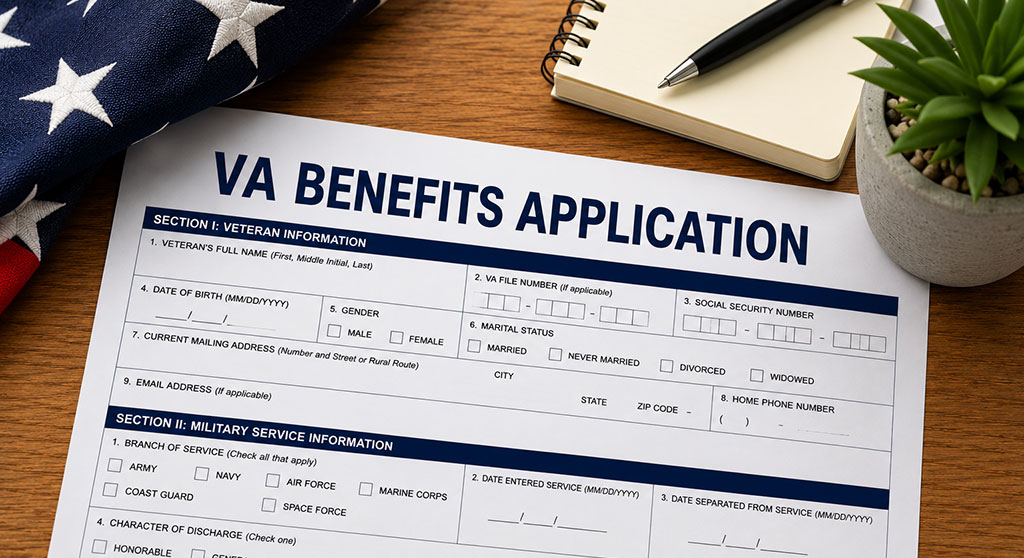
How to Apply for VA Housebound Benefits
Applying for the Housebound benefit follows the same general process as applying for Aid & Attendance. The key form is VA Form 21-2680 (Examination for Housebound Status or Permanent Need for Regular Aid and Attendance). Despite the form’s dual title, it is used for both programs — the physician completes the relevant sections based on whether the applicant’s situation reflects housebound status, a personal care need, or both.
Documents Needed
- VA Form 21-2680 — completed by a licensed physician, physician assistant, or advanced practice registered nurse; documents the nature of the disability and its effect on mobility and daily function
- Veteran’s DD-214 — discharge papers confirming wartime service and character of discharge; available through the National Archives at archives.gov
- Financial documentation — bank statements, investment account statements, and income records to support the net worth and income assessment
- Marriage certificate and death certificate (for surviving spouses) — to establish the marital relationship and the veteran’s death
- Evidence of care expenses — receipts or statements for unreimbursed medical costs that may reduce countable income
How to Submit the Application
A completed application can be submitted online through VA.gov, by mail to the appropriate Pension Management Center, or in person at a VA regional office. There is no fee to apply directly with the VA.
Processing time varies, but the VA typically takes several months to make a decision on pension-level claims. Claims with complete documentation and a clearly documented disability tend to move through the process more efficiently than those with missing forms or ambiguous medical evidence.
Common mistake: The physician’s section of VA Form 21-2680 is frequently incomplete. The VA needs specific details about where the veteran goes, how often they leave home, what activities they can perform independently, and how the disability physically limits their mobility. A vague or brief physician statement is one of the most common reasons Housebound claims are delayed or denied.
How Housebound Benefits Interact with Other VA Programs
Housebound Benefits and Aid & Attendance
As noted above, you cannot receive both at the same time. If a veteran currently receives the Housebound allowance and their care needs later increase to the point where they need regular personal assistance with daily activities, they can file for an upgrade to Aid & Attendance. The VA will reassess the claim and, if the higher standard is met, begin paying at the Aid & Attendance rate. The transition does not require starting over — it is a modification to an existing pension claim.
Housebound Benefits and Long-Term Care
Veterans who move from home into an assisted living community or nursing home do not necessarily lose access to pension-level benefits. Aid & Attendance — not the Housebound allowance — is typically the relevant benefit once a veteran enters a care facility, since the care need standard is more applicable than the housebound confinement standard in those settings. For more on how VA benefits apply across different care settings, see our guide on VA long-term care options for veterans and spouses.
Housebound Benefits and VA Disability Compensation
The pension-based Housebound benefit and VA disability compensation (including SMC-S) cannot be received at the same time. Veterans who receive VA disability compensation are generally not eligible for VA pension benefits simultaneously, because pension is a needs-based program and compensation is an entitlement program. Veterans and surviving spouses should work with a specialist to determine which program pays more in their specific situation before applying.
How Patriot Angels Can Help
The VA pension system — including the Housebound benefit — is a needs-based program with complex financial rules and specific documentation requirements. Understanding which benefit level applies, how to calculate countable income, what qualifies as an unreimbursed medical expense, and how to document the housebound condition properly all require careful attention to detail.
Patriot Angels has been helping wartime veterans and surviving spouses access VA benefits since 2012. Our Benefit Specialists work under the guidance of our VA-accredited attorney, Victoria L. Collier (Accreditation #9079), and offer a free consultation to help determine whether the Housebound benefit, Aid & Attendance, or another program is the right fit — and what the financial picture needs to look like to qualify.
Call (844) 757-3047 or request a free consultation online to get started.
If you or a loved one served our country, let us help you secure
the benefits you’ve earned.
Journey Today
Frequently Asked Questions
Common questions from veterans and families about VA Housebound benefits.
What are VA Housebound benefits?
VA Housebound benefits are an enhanced level of VA pension that adds monthly payments to the base pension for wartime veterans or surviving spouses who are substantially confined to their home due to a permanent disability. The benefit is tax-free and paid directly to the recipient — it is not a separate standalone program, but an increased pension tier within the same system as Aid & Attendance.
How much do VA Housebound benefits pay in 2026?
In 2026, the maximum Housebound benefit is $1,776 per month for a single veteran with no dependents, $2,223 per month for a veteran with a spouse or dependent child, $1,190 per month for a surviving spouse with no dependent child, and $1,490 per month for a surviving spouse with a dependent child. The actual payment depends on countable income after allowable deductions — most recipients receive less than the maximum.
What is the difference between Housebound benefits and Aid & Attendance?
Both are enhanced pension levels available to wartime veterans and surviving spouses, but they target different situations. Aid & Attendance is for people who need regular hands-on help with daily activities like bathing, dressing, or eating. Housebound is for people whose permanent disability substantially confines them to their home, regardless of whether they need personal care assistance. Aid & Attendance pays more. You cannot receive both at the same time — the VA pays whichever is higher if you qualify for both.
Does a veteran need a service-connected disability to qualify?
No. The pension-based Housebound benefit does not require a service-connected disability. The veteran must have served during a designated wartime period with an honorable or other-than-dishonorable discharge, but the disability causing the housebound condition does not need to be related to military service. A health condition that develops in later life — such as severe arthritis, heart disease, or a neurological condition — can qualify, as long as it is permanent and substantially confines the veteran or surviving spouse to the home.
Can I qualify if I occasionally leave home for doctor’s appointments?
Yes. The VA’s standard is “substantially confined” to the home — not completely unable to leave. Leaving home for medical appointments, essential errands, or brief infrequent outings does not disqualify someone. What matters is that a permanent disability prevents regular, routine activity outside the home. A physician’s statement documenting the disability and its effect on mobility and daily activity is required as part of the application.
Can a surviving spouse of a veteran receive Housebound benefits?
Yes. Surviving spouses of wartime veterans may qualify for the VA Housebound benefit. The surviving spouse must have been married to the veteran at the time of death, must not have remarried, and must meet the financial and medical requirements. In 2026, the maximum rate for a surviving spouse with no dependent child is $1,190 per month, tax-free.