
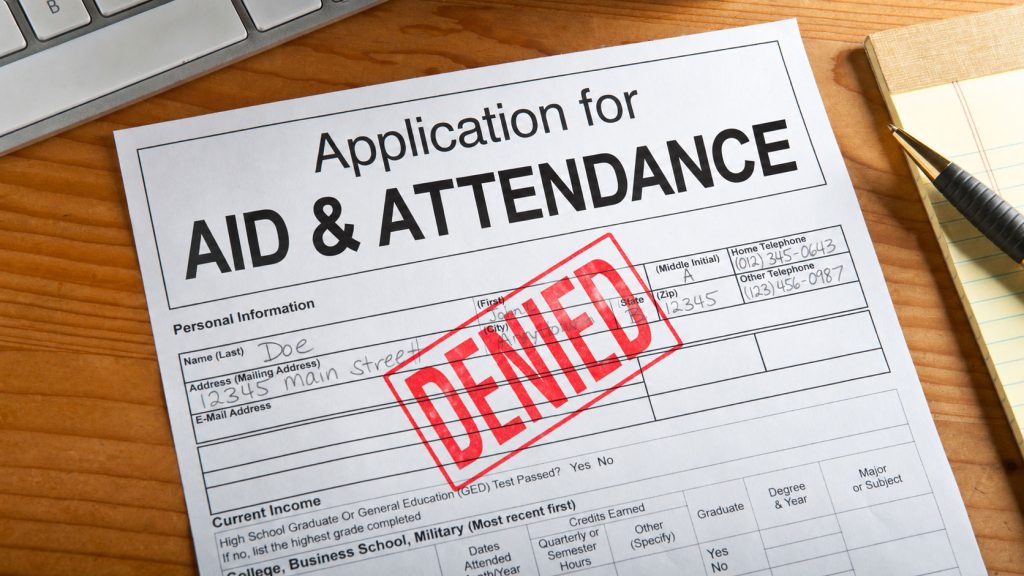
If you or someone you love applied for VA Aid & Attendance and received a denial letter, you are not alone. Denials happen more often than most families expect — and in many cases, the reason has nothing to do with whether the veteran or surviving spouse actually qualifies. More often, it comes down to how the claim was prepared and submitted.
Based on our experience helping more than 30,000 veterans and surviving spouses, our Benefit Specialists — working under the guidance of our VA-accredited attorney — have seen the same issues play out again and again. The five reasons below account for the vast majority of Aid & Attendance denials we encounter.
If you haven’t yet applied, this article can help you avoid these mistakes. If you’ve already received a denial, understanding why is the first step toward a successful appeal or resubmission. For a full overview of how the benefit works, start with our Aid & Attendance Fact Sheet.
1. Insufficient Medical Documentation
This is the single most common reason Aid & Attendance claims are denied. The VA requires clear, specific documentation showing the applicant needs assistance with at least two Activities of Daily Living (ADLs) — bathing, dressing, eating, toileting, or mobility. A general statement from a doctor that someone “needs help” or “has difficulty with daily tasks” is not enough.
The physician’s statement must describe the specific nature of the need — for example, that the applicant requires hands-on assistance getting in and out of a shower, or standby assistance to prevent falls while dressing. For individuals with dementia or cognitive impairment, supervision and verbal reminders also count, but this must be explicitly documented in the medical record.
What goes wrong: VA Form 21-2680 — the physician’s evaluation — is often completed too briefly. A doctor checking boxes without detailed written explanation gives the VA very little to work with. Vague or incomplete statements are one of the fastest paths to a denial.
The fix is ensuring the physician’s statement is thorough and specifically addresses each ADL the applicant needs help with. If cognitive impairment is a factor, the documentation should describe how it affects the person’s ability to function safely and independently on a day-to-day basis.
2. Incomplete Application Package
Many families search online for an Aid & Attendance application, find VA Form 21-2680, submit it, and wait — only to receive a denial or a development letter months later. What most people don’t realize is that this one form is just a small piece of a much larger claim package.
A complete Aid & Attendance claim requires dozens of pages across multiple forms, statements, affidavits, and supporting documents. Missing even one required component triggers a development process in which the VA reaches out to gather what’s missing. This can add months to the timeline — and if the requested information isn’t provided within the VA’s deadline, the claim may be denied entirely.
What goes wrong: Applicants submit only the physician’s form, or omit key supporting documents like financial statements, caregiver agreements, or net worth documentation. Each missing piece stalls the review process before it can begin.
A properly assembled claim package ensures the VA has everything it needs to make a decision without having to pause and request additional information — which is one of the most effective ways to avoid unnecessary delays and denials.
3. Financial Documentation Errors
Aid & Attendance is a pension benefit, which means financial eligibility matters. To qualify, the applicant’s net worth must be below $163,699 (the 2026 limit), and countable income must fall below the applicable Maximum Annual Pension Rate. Getting either of these calculations wrong can result in a denial.
Common financial documentation errors include failing to report all income sources, omitting assets, or failing to properly document medical expenses that reduce countable income. On the other side, some applicants incorrectly include assets that are actually exempt — such as the primary residence or a vehicle — which can make their financial picture look worse than it actually is.
What goes wrong: Unreported income or assets can result in denial. Equally problematic is failing to properly document qualifying medical expenses, which can significantly reduce countable income and improve the benefit outcome. Families who skip this step often receive less than they’re entitled to — or nothing at all.
Understanding exactly what counts as income, what counts as an asset, and what qualifies as a deductible medical expense is one of the more technically complex parts of an Aid & Attendance claim. For a detailed breakdown, see our guide on VA Aid & Attendance income limits and net worth requirements.
4. Errors on the Application Forms
The VA’s claim forms are detailed, and mistakes are easy to make — especially for someone navigating the process without prior experience. A missing signature, a blank required field, an outdated form version, or a simple data entry error can be enough to trigger a denial before the VA even gets to the question of medical or financial eligibility.
The regulations governing Aid & Attendance are contained in Title 38 of the Code of Federal Regulations, supplemented by thousands of pages of additional VA policy manuals. Veterans Service Representatives are trained on these materials. Most families applying on their own are not — which is why form errors are among the most frequent and most preventable causes of denial.
Worth knowing: If a VA representative makes an error while helping you complete your claim, that error can still result in a denial — and potentially years of appeals to correct. Careful review of every form before submission matters regardless of who helps you complete it.
Every section of every form needs to be completed accurately, signed where required, and submitted using the current version of the document. Outdated forms the VA has since revised are a more common issue than most people expect.
Not Sure If Your Claim Is Complete?
Our Benefit Specialists review claims every day and know exactly what the VA needs to see. There’s no cost to speak with us.
Get a Free Consultation5. Failure to Meet — or Prove — a Specific Eligibility Requirement
In some cases, the issue isn’t documentation but eligibility itself — or more precisely, the inability to demonstrate eligibility clearly enough to satisfy the VA’s review process. The most common eligibility-related denial reasons include:
- Wartime service: The veteran must have served at least 90 days of active duty with at least one day during a designated wartime period — World War II, the Korean Conflict, the Vietnam Era, or the Gulf War. Veterans who served only during peacetime periods may not qualify.
- Net worth above the limit: If the applicant’s net worth exceeds $163,699, the claim will be denied regardless of medical need. The VA also has a three-year look-back rule on asset transfers, so gifts or transfers made to reduce net worth within that window can be flagged.
- Discharge status: The veteran must have been discharged under conditions other than dishonorable. Certain discharge types can disqualify an otherwise eligible veteran.
- Care need not clearly established: If the medical documentation doesn’t clearly show the need for assistance with at least two ADLs, the care requirement is considered unproven — even if the need genuinely exists.
What Happens After a Denial?
A denial is not the end of the road. You have one year from the date of your denial letter to appeal. There are three paths: filing a Notice of Disagreement, requesting a Higher-Level Review by a senior VA rating specialist, or filing a Supplemental Claim with new evidence. In many cases, the right additional documentation is all that’s needed to reverse the decision. Our Benefit Specialists can review your denial letter and help you determine the best path forward.
Most Denials Are Preventable
The common thread running through nearly all of these denial reasons is that they are avoidable with proper preparation. The VA Aid & Attendance claim process is genuinely complex — the regulations are extensive, the forms are detailed, and the documentation standards are specific. That’s not a reason to give up on the benefit; it’s a reason to get experienced help before submitting.
Patriot Angels has helped more than 30,000 veterans and surviving spouses navigate this process since 2012. Our Benefit Specialists, working under the guidance of our VA-accredited attorney, know exactly what the VA needs to see — and how to present a claim that is complete, accurate, and supported by the right documentation. To learn more about current benefit amounts, see the 2026 Aid & Attendance benefit rates.
Call (844) 757-3047 or request a free consultation online to get started.
Don’t Let a Preventable Mistake Cost You the Benefit
Frequently Asked Questions
Common questions about Aid & Attendance denials and what to do next.
What is the most common reason for an Aid and Attendance denial?
Insufficient medical documentation is the most common reason. The VA requires specific, detailed evidence that the applicant needs help with at least two Activities of Daily Living. A vague or brief physician’s statement is frequently not enough to satisfy the VA’s requirements.
Can I appeal an Aid and Attendance denial?
Yes. You have one year from the date of your denial letter to appeal. The three options are filing a Notice of Disagreement, requesting a Higher-Level Review by a senior VA rating specialist, or filing a Supplemental Claim with new supporting evidence. In many cases, stronger documentation is all that is needed to reverse a denial.
Does net worth affect Aid and Attendance eligibility?
Yes. As of 2026, the net worth limit is $163,699. Applicants whose net worth exceeds this threshold are not eligible regardless of medical need. The VA also applies a three-year look-back rule on asset transfers made to reduce net worth before applying.
What should I do if I was denied because of missing documents?
A Supplemental Claim is often the right path when a denial stems from missing or incomplete documentation. This allows you to submit new evidence for review. Working with a Benefit Specialist before resubmitting helps ensure the same issues do not arise a second time.
How long does an Aid and Attendance claim take to process?
Processing times vary depending on the completeness of the claim and the VA’s current workload. A well-prepared, complete claim package is the most effective way to avoid delays caused by the VA having to request missing information.