
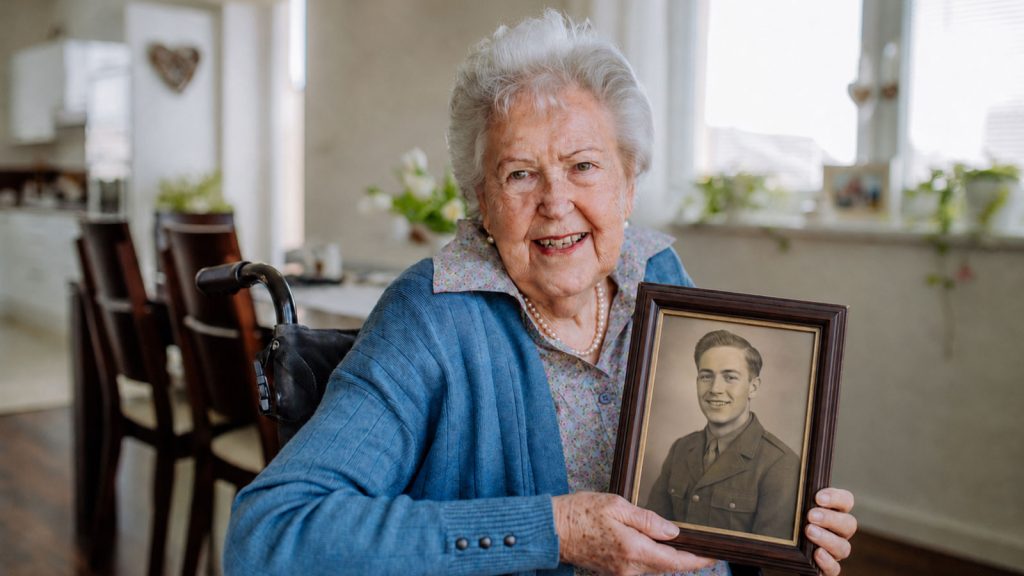
The World War II generation is nearly gone. Their widows are not. Fewer than 35,000 WWII veterans are still living, but the women who married them are a far larger group — and many are in assisted living, paying for home care, or being looked after by an adult child right now.
Most of them have no idea what they may be entitled to. The VA has at least eight separate programs open to a surviving spouse, and the largest of them pays up to $1,558 a month, tax-free, toward the cost of care. None of it arrives automatically. Every one of these benefits has to be claimed.
This page covers each benefit a widow of a World War II veteran may qualify for, the rules specific to WWII service, and the deadlines that quietly close the door on some of them.
Why WWII Widows Are the Most Overlooked Group
Of the families who contacted Patriot Angels this year about a World War II veteran and told us their relationship to him, 88% were the surviving spouse rather than the veteran. That is the most lopsided ratio of any war era we handle — for the Korean War it is 63%, for Vietnam 32%.
The arithmetic explains it. A man who enlisted in 1943 at twenty would be past a hundred today. His wife was often several years younger, and many WWII veterans married in the late 1940s and 1950s, after the war rather than during it. Widows in their late eighties and early nineties are common, and that is precisely the age at which care needs arrive.
A widow does not need to have been married during the war. The wartime requirement attaches to the veteran’s service dates, not the wedding date. A couple who married in 1952 can still qualify on his 1944 service.
Every VA Benefit a WWII Widow May Qualify For
Here is the full set at a glance. Each is explained in detail below.
| Benefit | What it provides |
|---|---|
| Survivors Pension | A tax-free monthly payment based on need. The foundation the other pension benefits are built on. |
| Aid & Attendance | An increased rate paid on top of Survivors Pension for a widow who needs help with daily care. Up to $1,558 a month in 2026. |
| Housebound benefits | An intermediate rate for a widow substantially confined to her home who does not meet the full Aid & Attendance standard. |
| Dependency and Indemnity Compensation | A tax-free monthly payment where the veteran’s death was connected to his service. Paid instead of Survivors Pension, never alongside it. |
| Accrued benefits and substitution | Money the VA owed the veteran but never paid before he died. A one-year filing deadline applies. |
| CHAMPVA healthcare | Health coverage sharing the cost of most care and prescriptions, where the veteran was rated permanently and totally disabled or died of a service-connected condition. |
| VA-backed home loan | Loan terms available to certain surviving spouses, for purchase or refinancing, with a Certificate of Eligibility. |
| Burial and memorial | Burial in a national cemetery, a headstone or marker, a burial flag, and in some cases a burial allowance. |
Most families come looking for one of these and discover they may be eligible for several. The monthly care payment is usually the largest, so we will start there.
Survivors Pension and Aid & Attendance
These two go together. Survivors Pension is a needs-based monthly payment to the unmarried surviving spouse of a wartime veteran whose death was not related to his service. Aid & Attendance is not a separate program — it is an increased rate paid on top of that pension when the widow needs regular help with her care.
Because the enhanced rate is so much higher than the base pension, this is the benefit most WWII widows are actually looking for even when they do not know its name. These are the 2026 figures, running December 1, 2025 through November 30, 2026.
| Who is claiming | Maximum monthly benefit |
|---|---|
| Surviving spouse | $1,558 |
| Single veteran | $2,424 |
| Married veteran | $2,874 |
| Two veterans married to each other | $3,845 |
The payment is tax-free and arrives monthly. There are no receipts to submit afterward and no restriction on which provider the money goes to. Full figures for every category are on the 2026 Aid & Attendance benefit rates page.
The four tests
A widow qualifies on her husband’s service and on her own present circumstances. Four things must be true at the same time.
His wartime service. At least 90 days of active duty with at least one day inside the recognized World War II period, and a discharge under conditions other than dishonorable. He did not have to deploy, be wounded, be decorated, or hold any disability rating. Stateside service inside the window satisfies the test in full.
Her need for care. A physician must document that she needs the regular assistance of another person with activities of daily living — bathing, dressing, eating, toileting, or transferring. She also meets this test if she is bedridden, resides in a nursing home because of physical or mental incapacity, or has corrected vision of 5/200 or less in both eyes.
Medication management, meal preparation, and transportation are not activities of daily living. They are helpful to document as part of the overall picture, but on their own they do not satisfy this test. The five listed above are what the VA is looking for.
There is no list of qualifying diagnoses. What matters is function, not the name of the condition. Dementia and Alzheimer’s routinely satisfy the test because of the supervision they require, covered further in VA benefits for dementia and Alzheimer’s care. Where the care happens does not matter either — assisted living, a memory care community, a nursing home, or her own house all count equally, and a family member can be paid to provide the care.
Net worth. Net worth including annual income must fall below $163,699. The house she lives in is excluded, along with a reasonable lot area, her vehicle, and ordinary household furnishings and personal effects. Bank accounts, investments, most retirement accounts, annuities, and real estate beyond the primary home do count. A three-year look-back applies to asset transfers, which means gifts made to children in the hope of qualifying often delay eligibility rather than help it. The income limit and net worth requirements page works through the details.
Income after care costs. The VA does not look at gross income. It looks at what remains after unreimbursed medical and care expenses are subtracted, and since care costs are usually what prompted the family to look into this, those deductions tend to be large. A widow drawing $3,200 a month from Social Security and a survivor annuity may look comfortable on paper and still qualify once $5,000 a month in assisted living is set against it. This is where families most often rule themselves out by mistake — the cost of long-term care for veterans is high enough that the calculation is worth running properly.
Find Out Where She Stands in One Conversation
Most families cannot tell from a website which of these she may qualify for. Our Benefit Specialists, working under the guidance of our VA-accredited attorney, will walk through the situation and tell you plainly what is worth pursuing.
See If You QualifyHousebound Benefits
Between the base Survivors Pension and the Aid & Attendance rate sits a third tier that families rarely hear about. Housebound benefits pay an intermediate rate to a widow who is substantially confined to her home by a disability reasonably certain to last the rest of her life, but who does not need the hands-on daily assistance that Aid & Attendance requires.
A widow cannot receive both — the VA pays one rate or the other. But a claim that falls short of the Aid & Attendance standard is not necessarily a claim that fails, and Housebound is the reason why. VA Housebound benefits covers who qualifies and what it pays.
Dependency and Indemnity Compensation
DIC is the other side of the survivor system. Where Survivors Pension is needs-based and applies when the death had nothing to do with service, DIC applies when the death did — either directly, or because the veteran was rated totally disabled from a service-connected condition for a qualifying period before he died.
DIC is not means-tested, which makes it more valuable to a widow whose finances would put Survivors Pension out of reach. A widow receives one or the other, never both, and the VA pays whichever is worth more. The differences are set out in DIC vs. Aid & Attendance.
For WWII widows specifically, DIC comes up less often than families expect — most of these men lived long lives and died of causes unconnected to their service. It is still worth checking, particularly where he carried a disability rating in later life.
Accrued Benefits and Substitution
This one has a deadline, and it is the benefit most often lost by families who simply did not know about it.
If the veteran died while a VA claim was still pending, or with a benefit awarded but not yet paid out, that money does not disappear. A surviving spouse can either substitute onto the pending claim and carry it through to a decision, or file for accrued benefits — the amounts that were due but never paid.
There is a one-year window. A claim for accrued benefits generally must be filed within one year of the veteran’s death. Families dealing with a funeral and an estate routinely miss it without ever knowing it existed.
This matters more for the World War II generation than for later eras. Claim backlogs in the years these men were filing were long, and a meaningful number died waiting on a decision. If your father or grandfather had anything in front of the VA when he passed, it is worth finding out what happened to it.
CHAMPVA Healthcare
The Civilian Health and Medical Program of the Department of Veterans Affairs shares the cost of most healthcare services and supplies, including prescriptions through its Meds by Mail service. A surviving spouse may be eligible where the veteran was rated permanently and totally disabled from a service-connected condition, died from a service-connected condition, or died in the line of duty.
For a widow already on Medicare, CHAMPVA generally acts as a secondary payer, picking up costs Medicare leaves behind. That can be substantial at this stage of life, and it is entirely separate from any pension claim — being eligible for one has no bearing on the other.
VA-Backed Home Loans
Certain surviving spouses can obtain a Certificate of Eligibility and use the VA home loan program in their own right — for a purchase, a cash-out refinance, or an interest rate reduction refinance. The program also offers financial counselling to borrowers struggling with payments on a VA-backed loan, which can help a widow stay in her home rather than lose it.
Eligibility here is narrower than for the pension benefits and generally tracks the same service-connection conditions as CHAMPVA. It is worth checking rather than assuming, particularly for a widow considering a move to be nearer family.
Burial and Memorial Benefits
A surviving spouse may be buried in a national cemetery and receive a headstone or marker and perpetual gravesite care. She does not have to be buried in the same cemetery as her husband, and she is not excluded from this if he was never interred in a national cemetery at all.
A burial allowance covering transportation and related costs is available in some circumstances. Families can also request a burial flag and a Presidential Memorial Certificate. These are among the simplest benefits to claim and among the most frequently overlooked.
Education benefits rarely apply here. The Survivors’ and Dependents’ Educational Assistance program and the Fry Scholarship are genuine surviving-spouse benefits, but both carry time limits measured from the veteran’s death or rating. For the widow of a World War II veteran, those windows have almost always closed.

The WWII Rules That Are Specific to This Era
The service window
The recognized World War II period runs from December 7, 1941 through December 31, 1946. Service continuing past that date still counts if it began inside the window.
Several groups outside the regular branches also qualify, and families frequently do not realise it. These include the Women Airforce Service Pilots, the Women’s Army Auxiliary Corps, the Guam Combat Patrol, Merchant Marines in oceangoing service between December 7, 1941 and August 15, 1945, and certain civilian flight crew and aviation ground support staff who served overseas under contract to the Air Transport Command.
Service dates are the most common reason a claim fails. Across our screenings, wartime service accounts for nearly half of all hard disqualifications — far more than income does. Locate the discharge papers before assuming anything either way.
The marriage date rule almost nobody mentions
Federal law sets a marriage requirement that varies by war era. Under 38 U.S.C. §1541(f), the surviving spouse of a World War II veteran must have married him before January 1, 1957.
That date stops families cold when they find it, and it should not. The statute gives two alternatives, and meeting any one of the three satisfies the rule:
- The marriage took place before January 1, 1957, or
- the marriage lasted one year or more, or
- a child was born of the marriage, or born to them before it.
In practice the second alternative resolves nearly every case. A marriage of a year or longer clears the requirement regardless of what year it began, which means a widow who married a WWII veteran in 1968 stands in the same position as one who married him in 1946. The 1957 date binds only very short marriages that produced no children.
When the discharge papers cannot be found
Documenting a World War II claim is harder than for any later era, for a specific reason: a 1973 fire at the National Personnel Records Center in St. Louis destroyed a large share of Army and Army Air Forces personnel files from the period.
A complete claim generally needs the veteran’s discharge papers or DD-214, his death certificate, the marriage certificate, and a physician’s statement describing the widow’s care needs. A missing DD-214 does not end the claim. Alternate proof of service can be assembled from surviving pay records, enlistment records, state adjutant general files, and VA records if he ever filed for anything in his lifetime.
Missing the discharge papers?
This is the single most common obstacle in a WWII claim and it is usually solvable. Do not abandon a claim over it before someone has looked at what other records exist. Call (844) 757-3047.
What Ends Eligibility
Two conditions close the door on the pension benefits, and together they account for roughly 12% of the disqualifications in our records — more than income does.
The marriage must have lasted until his death. A divorce ends eligibility permanently, regardless of how long the marriage ran beforehand. There is no partial credit for thirty years that ended in 1979.
Remarriage after his death generally ends eligibility for Survivors Pension with Aid & Attendance. There are narrow circumstances in which a widow whose later marriage has itself ended may still be able to claim on her first husband’s service, and the rules differ between Survivors Pension and DIC — DIC has age-based remarriage exceptions that Survivors Pension does not. If this describes your situation, it is worth asking rather than assuming the answer is no.
How Patriot Angels Helps
We work with families in exactly this position every day. Our Benefit Specialists, working under the guidance of our VA-accredited attorney, review the veteran’s service dates against the WWII window, assess the widow’s care needs and finances, identify which of these benefits are genuinely in play, and work out what documentation each will need before anything goes near the VA.
If the answer is that she does not qualify, we will say so plainly rather than let a family spend months on a claim that was never going to work. Reach us at (844) 757-3047 or through our free consultation page.
If you or a loved one served our country, let us help you secure
the benefits you’ve earned.
Journey Today
Frequently Asked Questions About VA Benefits for WWII Widows
Common questions from surviving spouses of World War II veterans and the families helping them.
What VA benefits can a widow of a WWII veteran receive?
A surviving spouse may qualify for as many as eight VA benefits. These are Survivors Pension, Aid & Attendance paid on top of that pension at up to $1,558 a month in 2026, Housebound benefits at an intermediate rate, Dependency and Indemnity Compensation where the death was service-connected, accrued benefits or substitution on a claim the veteran left pending, CHAMPVA healthcare, a VA-backed home loan, and burial and memorial benefits. A widow receives DIC or Survivors Pension but never both, and the VA pays whichever is worth more. Every one of these must be applied for; none is issued automatically.
How much does Aid & Attendance pay a WWII widow in 2026?
Up to $1,558 per month, tax-free, for a surviving spouse. These rates run from December 1, 2025 through November 30, 2026. The payment can go toward assisted living, a memory care community, nursing home care, or in-home care, and there is no restriction on which provider receives it. A family member can be paid to provide the care. Aid & Attendance is not a standalone program but an increased rate paid on top of the VA Survivors Pension when the widow needs regular help with her daily care.
What are the World War II service dates for VA benefits?
The recognized World War II period runs from December 7, 1941 through December 31, 1946. The veteran needed at least 90 days of active duty with at least one day inside that window and a discharge under conditions other than dishonorable. Combat service and overseas deployment are not required; stateside service inside those dates satisfies the test. Groups outside the regular branches also count, including the Women Airforce Service Pilots, the Women’s Army Auxiliary Corps, the Guam Combat Patrol, and Merchant Marines in oceangoing service between December 7, 1941 and August 15, 1945.
Does a WWII widow have to have been married during the war to qualify?
No. The wartime requirement attaches to the veteran’s service dates, not the wedding date, so a couple who married in 1952 can still qualify on his 1944 service. Federal law does set a marriage rule under 38 U.S.C. §1541(f), which for a World War II veteran asks that the marriage took place before January 1, 1957. The statute also accepts a marriage that lasted one year or more, or one that produced a child, and meeting any one of the three satisfies the rule. The one-year alternative resolves nearly every case.
Can a widow claim benefits the veteran was owed before he died?
Yes. If the veteran died with a VA claim still pending, or with a benefit awarded but not yet paid, a surviving spouse can substitute onto the pending claim and carry it to a decision, or file for accrued benefits covering amounts that were due but never paid. A claim for accrued benefits generally must be filed within one year of the veteran’s death. This is relevant for the World War II generation because claim backlogs in the years these men were filing were long, and a number of them died waiting on a decision.
What if the WWII veteran’s discharge papers cannot be found?
This is the most common obstacle in a World War II claim, partly because a 1973 fire at the National Personnel Records Center in St. Louis destroyed a large share of Army and Army Air Forces personnel files from the period. A missing DD-214 does not end a claim. Alternate proof of service can be assembled from surviving pay records, enlistment records, state adjutant general files, and VA records if the veteran filed for anything during his lifetime.
Can a WWII widow qualify if her income seems too high?
Often yes. The VA counts income after unreimbursed medical and care expenses are deducted rather than gross income, and care costs are usually substantial. A widow drawing $3,200 a month from Social Security and a survivor annuity may look comfortable on paper and still qualify once $5,000 a month in assisted living is set against it. Net worth including annual income must fall below $163,699 in 2026, with the primary residence, vehicle, and ordinary household furnishings excluded from that figure.
What counts as an activity of daily living for Aid & Attendance?
The VA looks at five: bathing, dressing, eating, toileting, and transferring. Assistance can be stand-by rather than hands-on, and it does not have to come from a licensed caregiver. Medication management, meal preparation, and transportation are not activities of daily living and do not satisfy this test on their own, although they are worth documenting as part of the overall picture. A claimant also meets the care test by being bedridden, residing in a nursing home due to physical or mental incapacity, or having corrected vision of 5/200 or less in both eyes.