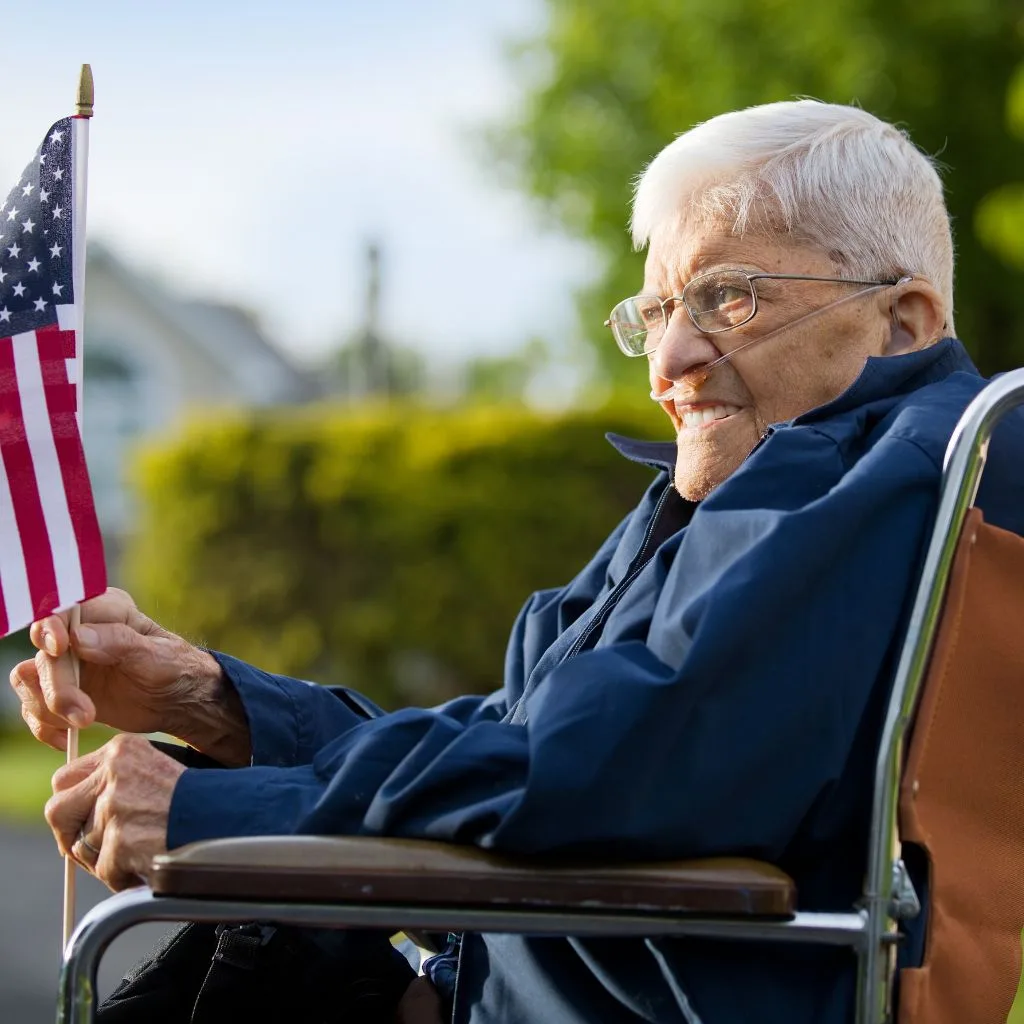


Dementia and Alzheimer’s disease affect millions of American families — and when the person living with cognitive decline is a wartime veteran or the surviving spouse of one, there is a VA benefit that many families never know to ask about. It is called Aid & Attendance, and it provides a significant monthly, tax-free payment that can be used to help cover the cost of whatever care the veteran or spouse needs.
What makes Aid & Attendance especially relevant for dementia and Alzheimer’s is how the VA defines qualifying care. The benefit does not require physical dependency alone — cognitive impairment is explicitly recognized as a basis for eligibility. Reminders, supervision, and standby assistance all count. And the benefit applies whether the veteran or spouse is living at home, in an assisted living community, or receiving any other form of long-term care.
This article explains exactly how Aid & Attendance applies to veterans and surviving spouses with dementia or Alzheimer’s disease — what qualifies, how much the benefit pays, and how to find out if your family may be eligible.
What Is the VA Aid & Attendance Benefit?
Aid & Attendance is an enhanced VA pension paid to wartime veterans, their dependent spouses, and surviving spouses who need assistance with activities of daily living or require custodial care due to a physical or cognitive condition. The benefit is tax-free and does not need to be paid back. For veterans and surviving spouses with dementia or Alzheimer’s disease, it is one of the most significant financial resources available — and one of the most overlooked. For a full overview, see our Aid & Attendance Fact Sheet.
Does Dementia Qualify for Aid & Attendance?
Yes — dementia and Alzheimer’s disease are among the most common qualifying conditions for the VA Aid & Attendance benefit. The key requirement is that the veteran or surviving spouse needs assistance with activities of daily living (ADLs) or requires custodial care. Cognitive decline almost always meets this standard.
The VA recognizes five activities of daily living: bathing, dressing, mobility, toileting, and eating. For individuals with dementia or Alzheimer’s, the assistance can take the form of reminders — such as reminders to bathe, change clothes, take medication, or eat. Physical hands-on help is not required in order to qualify.
Additionally, the VA recognizes custodial care as a qualifying need. Custodial care means the person requires assistance with at least two activities of daily living, or needs 24-hour supervision — a common situation for those living with moderate to advanced dementia. A veteran or spouse who requires ongoing supervision due to cognitive impairment can qualify for Aid & Attendance even if they do not need direct physical assistance with every ADL.
What counts as qualifying care for dementia? For veterans or surviving spouses with dementia or Alzheimer’s, qualifying care includes reminders to bathe, dress, eat, or take medication; standby assistance — being present nearby to prevent injury; physical help with any of the five activities of daily living; and 24-hour supervision due to cognitive impairment or safety risk. This care can be provided at home by a family member or professional caregiver, or in a memory care community, assisted living community, or skilled nursing facility.
How Dementia and Alzheimer’s Affect Daily Living — and Why It Matters for the VA
When a person is living with dementia or Alzheimer’s disease, the way they need assistance changes over time — and the VA’s benefit structure is designed to recognize that. Understanding how the VA evaluates cognitive impairment is key to understanding why so many veterans and surviving spouses with dementia qualify.
How Cognitive Impairment Satisfies the ADL Requirement
The VA requires that a veteran or surviving spouse need help with activities of daily living — bathing, dressing, mobility, toileting, and eating — or require custodial care. For someone with dementia or Alzheimer’s, these needs often look different than they do for someone with a purely physical limitation. In cases of cognitive impairment, the VA explicitly recognizes that assistance can take the form of reminders. A person with Alzheimer’s who needs to be reminded to bathe, change their clothes, or eat a meal meets the ADL requirement — even if they are physically capable of performing those tasks once prompted. This is a critical distinction that many families miss, and it is why dementia and Alzheimer’s are among the most common qualifying conditions for Aid & Attendance.
Custodial Care and 24-Hour Supervision
As dementia progresses, many individuals require more than reminders — they need someone present at all times to ensure their safety. The VA recognizes custodial care as a separate qualifying standard. Custodial care means the person requires assistance with at least two activities of daily living, or needs 24-hour supervision due to mental or cognitive impairment. A veteran or surviving spouse with moderate to advanced Alzheimer’s — who wanders, cannot be left alone safely, or requires constant orientation and redirection — typically meets the custodial care standard even if they do not need direct physical help with every ADL. This means the threshold for qualification is often lower than families expect.
What Care Settings Qualify
One of the most common misconceptions about Aid & Attendance is that it only applies in a facility setting. It does not. The benefit covers care wherever the veteran or surviving spouse receives it — at home, in an assisted living community, in a memory care unit, in a board and care home, or in a skilled nursing facility. Care at home can be provided by a professional caregiver, a home care agency, or a family member (other than the spouse), and no professional license is required. For families where a loved one with dementia is still living at home, the benefit can help offset the cost of in-home care directly. For more information, see our article on VA benefits for in-home care. For those in an assisted living or memory care community, learn more in our article on the assisted living benefit for veterans and surviving spouses.
Standby Assistance and Safety Supervision
Standby assistance — having another person present nearby to prevent injury — also counts as qualifying care under the VA’s rules. For a veteran or surviving spouse with dementia who is at risk of falling, getting lost, or making unsafe decisions, this form of supervision satisfies the ADL requirement even without direct physical assistance being given in the moment. This means that a caregiver who is present in the home specifically to monitor safety and intervene when needed is providing qualifying care, even during periods when the person with dementia appears calm or cooperative.
Medication Management and Other Considerations
One important clarification: medication management, meal preparation, transportation, and housekeeping are classified by the VA as Instrumental Activities of Daily Living (IADLs), not ADLs. On their own, these do not qualify someone for Aid & Attendance. However, for most veterans and surviving spouses with dementia, assistance with true ADLs or the need for supervision is also present — which is what establishes eligibility. If you are unsure whether a particular care situation qualifies, the answer is almost always to have a Benefit Specialist evaluate the specific circumstances rather than assume it does not qualify.
2026 Aid & Attendance Benefit Amounts
The Aid & Attendance benefit is a monthly tax-free payment. The current 2026 Aid & Attendance benefit rates are:
| Recipient | Monthly Benefit | Annual Benefit |
|---|---|---|
| Surviving Spouse | $1,558 | $18,694 |
| Single Veteran | $2,424 | $29,087 |
| Married Veteran | $2,874 | $34,489 |
| Two Veterans Married | $3,845 | $46,143 |
For families managing the cost of dementia care — whether at home or in a care community — these amounts can make a meaningful difference. Many families are surprised to learn this benefit exists and that their loved one may already qualify.
Caring for a Loved One With Alzheimer’s or Dementia?
Our Benefit Specialists, working under the guidance of our VA-accredited attorney, will help you understand the VA benefits that can help cover memory care.
Get StartedWho Qualifies for Aid & Attendance?
To qualify for the Aid & Attendance benefit, several requirements must be met. These apply whether the claimant is a veteran or a surviving spouse.
The veteran must have served during a wartime period. This does not mean the veteran had to serve in combat or overseas. It means they were on active duty during one of the officially recognized wartime periods established by Congress: World War II (December 7, 1941 – December 31, 1946), the Korean War (June 27, 1950 – January 31, 1955), the Vietnam War Era (November 1, 1955 – May 7, 1975 for veterans who served in the Republic of Vietnam; August 5, 1964 – May 7, 1975 for veterans who served anywhere in the world), and the Gulf War (August 2, 1990 through a date not yet determined by law). The veteran must have served at least 90 days of active duty with at least one wartime day and been discharged under conditions other than dishonorable.
Veterans must be 65 or older to qualify based on age. Veterans under 65 may still qualify if they are totally and permanently disabled. There is no age requirement for a surviving spouse.
The veteran or surviving spouse must need assistance with activities of daily living or require custodial care. As described above, cognitive impairment from dementia or Alzheimer’s disease typically satisfies this requirement — even when the assistance takes the form of reminders or supervision rather than direct physical help.
Income and net worth must be within the VA’s limits. The net worth limit for 2026 is $163,699. However, the VA’s calculation allows for deductions — including unreimbursed care expenses — which can significantly reduce countable income and bring many families within the limits even when initial numbers appear too high. There is also a three-year look-back period on asset transfers. For a full explanation, see our article on VA Aid & Attendance income limits and net worth requirements.
Don’t assume you won’t qualify. Many families assume they are over the asset limit because of a home, savings, or Social Security income. In many cases, those assumptions are wrong. Unreimbursed care costs — including dementia care at home or in a community — can dramatically reduce countable income under the VA’s formula. The only way to know for certain is to have a qualified Benefit Specialist review your situation.
For surviving spouses: the surviving spouse of a deceased wartime veteran may also qualify for Aid & Attendance in their own right. To be eligible, the surviving spouse must have been married to the veteran for at least one year prior to the veteran’s passing, must have been married at the time of death, and must not have remarried. There is no age requirement for surviving spouses. For more information, visit our page on Aid & Attendance for surviving spouses.
Can a family member be paid to provide dementia care? Yes — in many cases, an adult child or other family member can serve as a paid caregiver, and the Aid & Attendance benefit can help reimburse those care costs. The arrangement must be properly structured and documented to satisfy VA requirements. The spouse of a living veteran cannot be paid as a caregiver. Learn more: Can a Family Member Be Paid to Care for a Veteran or Surviving Spouse?
Why This Benefit Is So Often Missed
Thousands of veterans and surviving spouses with dementia are eligible for Aid & Attendance but never apply — often because they simply don’t know the benefit exists, or they assume they won’t qualify because of their income or assets. Some families believe the benefit is only for those in VA facilities or nursing homes. In reality, Aid & Attendance is a broad long-term care benefit that applies across care settings, and many people with significant assets still qualify once care expenses are properly calculated.
Applying without guidance is also a common reason claims are delayed or denied. The application involves dozens of pages of forms, affidavits, financial documentation, medical evidence, and military service records. Errors or missing documentation can result in denial — or a benefit amount lower than what the applicant is entitled to. The benefit is not retroactive in most circumstances, which means every month without a completed application is a month of benefits that cannot be recovered.
How Patriot Angels Can Help
Since 2012, Patriot Angels has helped more than 30,000 veterans and surviving spouses secure over $1 billion in Aid & Attendance benefits. Our Benefit Specialists, under the guidance of our VA-accredited attorney, understand the complexities of the application process — including claims involving dementia and Alzheimer’s disease.
We offer a free eligibility assessment to help you understand whether a veteran or surviving spouse may qualify. Call us at (844) 757-3047 or start a free consultation online today. Our Benefit Specialists will review your situation, answer your questions, and let you know exactly where you stand — with no pressure and no obligation.
If you or a loved one served our country, let us help you secure
the benefits you’ve earned.
Journey Today
Frequently Asked Questions
Common questions about VA Aid & Attendance for veterans and surviving spouses living with dementia or Alzheimer’s disease.
Does dementia qualify a veteran for Aid & Attendance?
Yes. Dementia and Alzheimer’s disease are among the most common qualifying conditions for VA Aid & Attendance. The benefit requires that the veteran or surviving spouse need assistance with activities of daily living or require custodial care. For those with cognitive impairment, this can include reminders to bathe, dress, or eat, as well as 24-hour supervision due to safety concerns.
Does Alzheimer’s disease qualify for Aid & Attendance?
Yes. Alzheimer’s disease qualifies under the same rules as other forms of dementia. The VA recognizes that cognitive impairment affects the ability to perform activities of daily living, and that assistance can take the form of reminders, supervision, and standby assistance. For most people with Alzheimer’s, these needs are present from the early stages of the disease.
Can a family member be paid to care for a veteran with dementia?
In many cases, yes. Adult children and other family members can serve as paid caregivers, and Aid & Attendance can help reimburse those care costs. The spouse of a living veteran cannot be paid as a caregiver. The arrangement must be properly structured and documented to satisfy VA requirements.
Does the veteran or surviving spouse need to be in a facility to qualify?
No. Aid & Attendance applies equally to care at home and care in a facility. A veteran or surviving spouse with dementia who receives qualifying care at home — from a family member, professional caregiver, or home care agency — is just as eligible as someone in an assisted living or memory care community.
What is the Aid & Attendance benefit amount for 2026?
The 2026 Aid & Attendance benefit rates are: Surviving Spouse – $1,558/month; Single Veteran – $2,424/month; Married Veteran – $2,874/month; Two Veterans Married – $3,845/month. These amounts are tax-free and do not need to be repaid.
Does a veteran with dementia need to have served in combat to qualify?
No. Combat service is not required. The veteran must have served at least 90 days of active duty with at least one day during an eligible wartime period — World War II, the Korean Conflict, the Vietnam War Era, or the Gulf War — and received an other-than-dishonorable discharge.